You’re staring at your birth chart — that dizzying wheel of glyphs, colored lines, and mysterious symbols — and thinking, where on earth do I begin? If you’ve ever tried to figure out how to read a birth chart and immediately closed the tab in overwhelm, you’re not alone. Most beginners get handed a chart and expected to interpret 12 houses, 10 planets, 5 major aspects, and a fistful of angles in one sitting. It’s like being given a novel in a language you’re still learning and asked to write the book report by tomorrow.
Here’s the good news: you don’t need to understand the whole chart to start reading yours today. In fact, once you know how to focus on the right three placements first, you can pull real, personal insight out of your birth chart in the next five minutes. In this warm-mystical beginner’s guide, we’ll show you exactly how to read a birth chart in 2026 — starting with the essentials, working through a real example, and giving you a runway into the deeper layers when you’re ready.
What Your Birth Chart Actually Is (In Plain English)
Your birth chart (also called your natal chart) is a snapshot of the sky at the exact moment you were born, taken from your exact birthplace on Earth. Imagine freezing time the second you took your first breath, then drawing a map of where every planet, luminary, and constellation was sitting overhead and around the horizon. That map is your chart. It’s part astronomy, part symbolism, and — the way astrologers use it — part self-portrait.
Astrologers read that snapshot like a personal blueprint. The signs describe how planetary energies express themselves in you. The houses describe where in your life those energies play out. The aspects — the geometric angles between planets — describe how the different parts of you talk to (or argue with) each other. Together, they form a symbolic language that describes the raw material of your personality, motivations, and unfolding story.
Here’s the important reframe: your chart is not a prediction, and it is not a limit. It’s a starting map. Your free will, your choices, your upbringing, and everything you do with your life shape what happens on top of that map. Learning how to read a birth chart is really learning to recognize your own patterns with more compassion — and use them on purpose.
What You Need Before You Start (Birth Date, Time & Place)
To generate an accurate birth chart, you need three data points. Get them right and the whole chart clicks into focus. Guess at any one of them and you’ll be reading a version of yourself that isn’t quite you.
- Your birth date. Month, day, and year. This determines your sun sign and the day-position of every other planet.
- Your exact birth time. Not “sometime in the morning.” Ideally to the minute. Your birth time controls your rising sign (which changes signs every ~2 hours) and the entire structure of the 12 houses. Without a time, your chart is a general portrait, not a personal one.
- Your birth city and country. The location on Earth changes what part of the sky was rising over the horizon at your birth. Same date and time in Bali versus Boston produces a completely different chart.
Don’t know your birth time? Check your birth certificate (the long-form, not the short-form). Ask a parent or family member. If a time is truly unavailable, you can still work with a solar chart — but expect the rising sign and house placements to be approximate at best.
Once you have those three details, any free calculator will draw the wheel for you. The tools do the astronomy; your job is to read the map. Which brings us to the part that trips most people up: which parts of the map matter first?
The Big Three: How to Read a Birth Chart Starting With Sun, Moon & Rising

If you take one thing from this guide, take this: always start with your Big Three. Every rich, personal reading of a natal chart begins with the sun, moon, and ascendant (rising) — your astrological trinity. These three placements alone will tell you more about who you are than a rushed tour through all ten planets and twelve houses. Master them first. Everything else layers on top.
Your Sun Sign: The Identity You’re Growing Into
The sun sign is what most people already know — “I’m a Cancer,” “I’m a Leo.” Your sun sign describes the essential identity you’re growing into over your lifetime. Think of it as the qualities you’re here to cultivate: a Leo sun is here to embody courage, warmth, and creative self-expression. A Virgo sun is here to refine, serve, and master craft. The house your sun sits in tells you where in life you’ll be developing that identity most vividly — career, relationships, home life, spirituality, and so on.
Your Moon Sign: The Inner You Nobody Sees
Your moon sign is your emotional world — how you feel, soothe yourself, and process what happens to you. Two people with the same sun sign can feel completely different on the inside because their moons are worlds apart. A sunny, confident Leo sun with a Scorpio moon has a private inner life that most people never guess. Reading your moon sign — its element, its house, and what soothes it — is often the fastest way to feel seen by your own chart.
Your Rising Sign: The Doorway You Walk Through
The rising sign, or ascendant, is the sign that was rising on the eastern horizon at the exact moment you were born. It sets the entire structure of your chart’s houses. Think of it as your energetic doorway — the first impression you give, your default approach to new situations, and the style of your body and physical presence. A Cancer rising softens you into a nurturing, protective vibe. An Aries rising leads with initiative and sharpness. Learn how your moon sign colors your rising’s expression and you’ll start to see why two Libra risings can feel so different.
Read all three together and a real portrait emerges. You are not just a sun sign. You are a Leo sun (identity), a Scorpio moon (emotional world), and an Aries rising (approach) — and that combination is uniquely you.
A Worked Example: Meet Sarah’s Chart

Let’s put this into practice with a made-up example: Sarah, born July 15, 1994, at 7:23 PM in Chicago. Her Big Three come out as:
- Cancer Sun in the 4th house
- Scorpio Moon in the 8th house
- Aries Rising
Reading her sun. Sarah’s Cancer sun tells us she’s here to grow into a nurturing, emotionally attuned identity — someone who builds a home, tends to her people, and honors her feelings as valid data. The sun landing in her 4th house (home, family, roots) doubles down on that theme: the arena where she’ll most powerfully develop her identity is literally her home life. She may become the person her family orbits around. She may build a career around wellness, hospitality, or family-adjacent work. Cancer season this year has a special magnetism for her because the sun is coming home to her sign.
Reading her moon. Her Scorpio moon says her inner emotional life is intense. She doesn’t do surface feelings. She goes all in, and she needs privacy to process. In the 8th house (intimacy, transformation, shared resources), her moon is doubly Scorpionic — she’s soothed by deep one-on-one connection, taboo topics, therapy, and rituals that acknowledge what’s really going on underneath. When her emotions run high, she needs solitude, not small talk.
Reading her rising. Aries rising gives Sarah a first impression that’s crisper and more direct than you’d expect for a Cancer sun. People meet her and see initiative, speed, and a willingness to lead. She may look sportier, more angular, or more physically active than the “soft Cancer” stereotype. This is why the Big Three matter: without her rising, you’d misread her at the door and miss the fire she leads with — even though her core is water.
See how the picture builds? Sun tells you the growing-into. Moon tells you the inner life. Rising tells you the doorway. All three together — and you already know Sarah far better than her Instagram bio ever will.

Wear Your Big Three With Pride
Now that you know how to read your chart, why not wear it? Our warm-mystical constellation collection lets you rock your sun, moon, or rising sign wherever you go — soft, thoughtful, and made for the star-seekers.
What the 12 Houses Reveal (Once You’re Ready for Round Two)
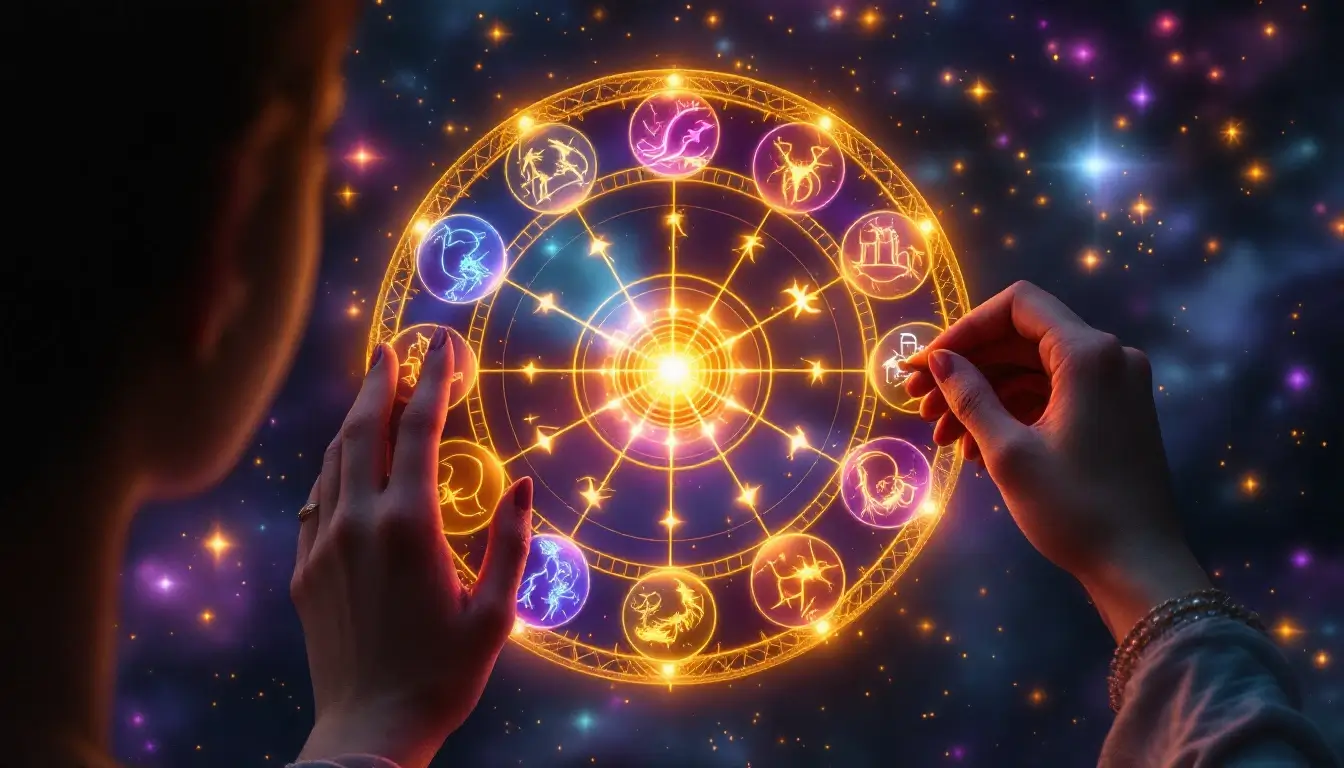
Once your Big Three feel familiar, the next layer of learning how to read a birth chart is the houses. The chart wheel is divided into 12 pie-slice sections — the houses — and each one governs a specific area of life. Wherever a planet lives, that’s the arena of life it colors. Here’s a quick tour so the map isn’t a mystery.
- 1st House — Self & Body. Your identity, appearance, first impressions. Ruled by your rising sign.
- 2nd House — Money & Values. Income, possessions, what you find valuable.
- 3rd House — Mind & Siblings. Communication, learning, short trips, siblings, neighbors.
- 4th House — Home & Roots. Family of origin, private home life, ancestry.
- 5th House — Play & Creativity. Romance, creativity, children, joy, self-expression.
- 6th House — Work & Health. Daily routines, service, health, pets.
- 7th House — Partnership. One-on-one relationships, marriage, business partners, open enemies.
- 8th House — Depth & Transformation. Intimacy, shared resources, taboo, therapy, inheritance.
- 9th House — Meaning & Travel. Higher education, publishing, long-distance travel, philosophy.
- 10th House — Career & Public Life. Reputation, calling, authority, life direction.
- 11th House — Community & Future. Friends, groups, hopes, technology, activism.
- 12th House — Solitude & Spirit. The unconscious, dreams, mysticism, hidden patterns.
Read a planet’s house first, then its sign. “My Venus is in the 7th” tells you love and partnership are a major theme. “My Venus is in the 7th in Sagittarius” tells you how — with freedom, adventure, and a partner who feels like a travel companion. Speaking of Venus-in-anything, if you love a good outfit as much as we do, our zodiac collection at We Love Horoscope is a warm-mystical way to wear your Big Three with pride — think Cancer moon soft tees and Aries rising bold prints.
The Planets & Their Roles (Quick Reference)
The planets in astrology aren’t just balls of rock and gas — they’re symbolic characters, each with a role to play in your inner cast. When you’re learning how to read a birth chart, thinking of them as archetypes — universal patterns of energy — makes them come alive. Here are the ten classical planets astrologers use, plus what each one governs.
- Sun — Identity, vitality, ego, the self you’re growing into.
- Moon — Emotions, needs, subconscious, what soothes you.
- Mercury — Thinking, speaking, learning, siblings, short trips. When Mercury goes backward, we say it’s in retrograde — a familiar phrase you’ve likely heard.
- Venus — Love, beauty, values, pleasure, money style.
- Mars — Drive, desire, anger, action, sex, sport.
- Jupiter — Growth, luck, faith, expansion, meaning, teachers.
- Saturn — Structure, discipline, limits, time, authority, mastery.
- Uranus — Rebellion, breakthrough, individuality, sudden change.
- Neptune — Dreams, mysticism, illusion, art, dissolution.
- Pluto — Power, transformation, obsession, death and rebirth.
The formula astrologers use to read any planet is: planet + sign + house. That’s the trifecta. Which energy (the planet), expressed how (the sign), in what area of life (the house). Once you can string that trifecta together for your Big Three, you’re already reading your chart. From there, you can add Mercury, Venus, and Mars — the “personal planets” that shape day-to-day personality — and you’ll have covered the six most influential placements in your natal chart.
Common Beginner Mistakes (And How to Skip Them)

A quick lightning round of the traps we see beginners fall into again and again while learning how to read a birth chart. Skip these and you’ll leapfrog months of frustration.
Mistake #1: Reading the Sun Sign Alone
Ninety percent of pop-astrology only reads the sun. If you’re a “Gemini” who feels nothing like a Gemini, it’s almost certainly because your moon and rising are pulling you in a different direction. Never read just the sun. Always read the Big Three as a set.
Mistake #2: Ignoring the Houses
Signs describe how a planet acts. Houses describe where it plays out. A moon in Leo in the 12th house is very different from a moon in Leo in the 5th house — same energy, radically different arena. When you meet a placement, always ask both questions.
Mistake #3: Chasing Aspects Before You Know the Basics
Aspects — trines, squares, oppositions, conjunctions — are the geometry between planets, and they’re powerful. But they’re advanced. Get comfortable with your Big Three, then the personal planets, then the houses, before you start decoding a square from Mars to Saturn. Otherwise you’ll drown in interpretations that don’t yet mean anything to you.
Mistake #4: Believing Your Chart Is a Life Sentence
Your birth chart is a map, not a script. A “hard” placement — a Saturn on the ascendant, a Pluto in the 7th, a Mars-Chiron square — isn’t a curse. It’s a growth zone. Almost every “difficult” chart placement becomes a superpower with awareness, therapy, and time. Read your chart with compassion for the person who was born under it.
Mistake #5: Skipping Your Birth Time
We said it above and we’ll say it again: without an accurate birth time, you can’t read the rising sign or the houses accurately. If in doubt, ask your family or check the certificate. It’s worth the phone call.
Frequently Asked Questions About Reading Your Birth Chart
How long does it take to learn how to read a birth chart?
You can read your Big Three in under an hour. Getting confident with your personal planets and houses is a matter of weeks of practice. Getting fluent — reading a stranger’s chart in real time — takes months to years of study, but you don’t need to be fluent to gain real insight from your own.
Do I need a professional astrologer to read my chart?
No. A beginner reading of your own chart using this method is a beautiful, valid starting point. A professional astrologer is worth it for a deep-dive session, a specific life question, or when major transits (like Saturn returns) are on the horizon — but you don’t need one to learn.
What if I don’t know my exact birth time?
Start with a solar chart (which uses noon as a placeholder time). You’ll get an accurate read on your sun, moon, and personal planets — and a very approximate house structure. If you want a full read, an experienced astrologer can offer a chart rectification, which reverse-engineers your birth time from major life events.
Which house system should I use?
For beginners, we recommend whole sign houses — the oldest system and the easiest to read (each sign is one whole house). Placidus, Koch, and Equal are common alternatives. If your chart looks wildly different across two systems, don’t panic — the planets, signs, and Big Three stay the same. Only the house placements shift.
Can my birth chart change over time?
Your natal chart is fixed the moment you’re born. But transits — the way today’s sky interacts with your fixed chart — are always in motion. That’s why an astrologer will say things like “Jupiter is transiting your 10th house this year” or “Saturn is returning to its natal position.” Your natal chart is the map; transits are the weather passing over it.
Final Thoughts: Your Chart Is a Beginning, Not a Verdict
Learning how to read a birth chart is not about memorizing everything at once. It’s about learning to see yourself in symbolic language — and to greet each layer of your chart with curiosity instead of overwhelm. Start with your Big Three. Read them as a trio. Then, when you’re ready, add the houses. Then the personal planets. Then the aspects. Layer by layer, you’ll build a self-portrait that gets richer every year.
And when you feel stuck, remember: the chart itself isn’t the destination. The self-knowledge is. Every glyph on that wheel is pointing you back to a version of you that’s already there, waiting to be recognized. If you want to keep going, our complete astrology 2026 mid-year guide shows exactly which transits are lighting up your chart right now — and our zodiac compatibility test takes your Big Three even further into how you love, argue, and grow with others.
The sky was doing something specific the moment you took your first breath. Now you know how to listen to it. ✨

Your Stars, Your Inbox
Get weekly horoscope insights, cosmic guidance, and exclusive offers delivered straight to your inbox. Join our community of star-seekers today.