If you’ve ever had your birth chart read and heard an astrologer rattle off “Venus in Scorpio” or “Saturn in the tenth house” like it explained everything about you, you already know that planets in astrology carry a lot more weight than the eight (or ten, if you’re counting the Sun and Moon) bodies you learned about in science class. Each planet is a symbolic character with its own personality, its own agenda, and its own way of showing up in your life — and understanding planet meanings is the single fastest way to go from “I know my sun sign” to actually reading a chart.
In this guide, we’re breaking down what every planet means in astrology — from the fast-moving personal planets that shape your day-to-day moods to the slow, generational giants that quietly define entire eras. We’ll also cover Chiron, the wounded healer that most planet guides leave out, and show you exactly how to find your own placements and read what’s happening in the sky right now.
What Are Planets in Astrology, Really?
In astrology, a “planet” isn’t quite the same thing as a planet in astronomy. Astrologers work with ten classical planets: the Sun, the Moon, Mercury, Venus, Mars, Jupiter, Saturn, Uranus, Neptune, and Pluto. Astronomically, the Sun is a star and the Moon is a satellite, and Pluto was reclassified as a dwarf planet back in 2006 — but none of that matters to your birth chart. In astrology, all ten are treated as equally important players, each ruling a different piece of your inner world.
Astrologers group the planets into three families based on how quickly they move and how broadly their influence reaches:
- Personal planets (Sun, Moon, Mercury, Venus, Mars) — move quickly through the zodiac, sometimes changing signs in days or weeks, and shape your individual personality, moods, and relationships.
- Social planets (Jupiter, Saturn) — move more slowly, spending about a year (Jupiter) or two-and-a-half years (Saturn) in each sign, and shape how you engage with society, structure, and growth.
- Generational planets (Uranus, Neptune, Pluto) — move so slowly that everyone born within several years of you shares the same sign placement. These describe the broad cultural shifts your entire generation lives through.
Once you understand these three tiers, the whole system starts to click. A placement in a personal planet tells you something intimate and specific about you. A placement in a generational planet tells you something you share with millions of people your age — the real personal story shows up in which house that planet occupies in your own chart, which we’ll get to below.
The Personal Planets: Sun, Moon, Mercury, Venus & Mars

The personal planets are the ones that show up in casual astrology conversation — “what’s your Venus sign?” — because they move fast enough to feel genuinely personal, and because they govern the parts of you that feel most like, well, you.
The Sun: Your Core Identity
Your Sun sign — the one everyone means when they ask “what’s your sign?” — represents your essential identity, your ego, and the life force you’re here to develop and express. It’s the character you’re growing into over the course of your life. If you want to understand how your Sun works alongside your Moon and rising sign, our guide to Sun, Moon, and Rising sign meaning breaks down the “Big Three” in full.
The Moon: Your Emotional Inner World
If the Sun is who you’re becoming, the Moon is who you already are underneath it all. It governs your instinctive emotional reactions, your comfort needs, and what makes you feel safe. Moon signs shift roughly every two and a half days, which is why two people born hours apart can have wildly different emotional temperaments. Dive deeper in our full Moon sign meaning guide.
Mercury: Your Mind and Voice
Mercury rules how you think, process information, and communicate — everything from your texting style to how you argue. When Mercury goes retrograde (which happens three to four times a year), it’s this planet’s territory that gets scrambled: crossed wires, miscommunications, and tech glitches.
Venus: Love, Beauty & What You’re Drawn To
Venus governs romance, aesthetics, pleasure, and what — and who — you find attractive. Your Venus sign shapes your love language far more than your Sun sign does, which is why Venus placements are often the first thing serious astrologers check for compatibility.
Mars: Drive, Desire & Action
Mars is your inner engine — how you assert yourself, chase what you want, and handle conflict. A well-placed Mars shows up as confident, direct energy; a more challenged Mars placement can show up as impatience or a short fuse.
The Social Planets: Jupiter and Saturn
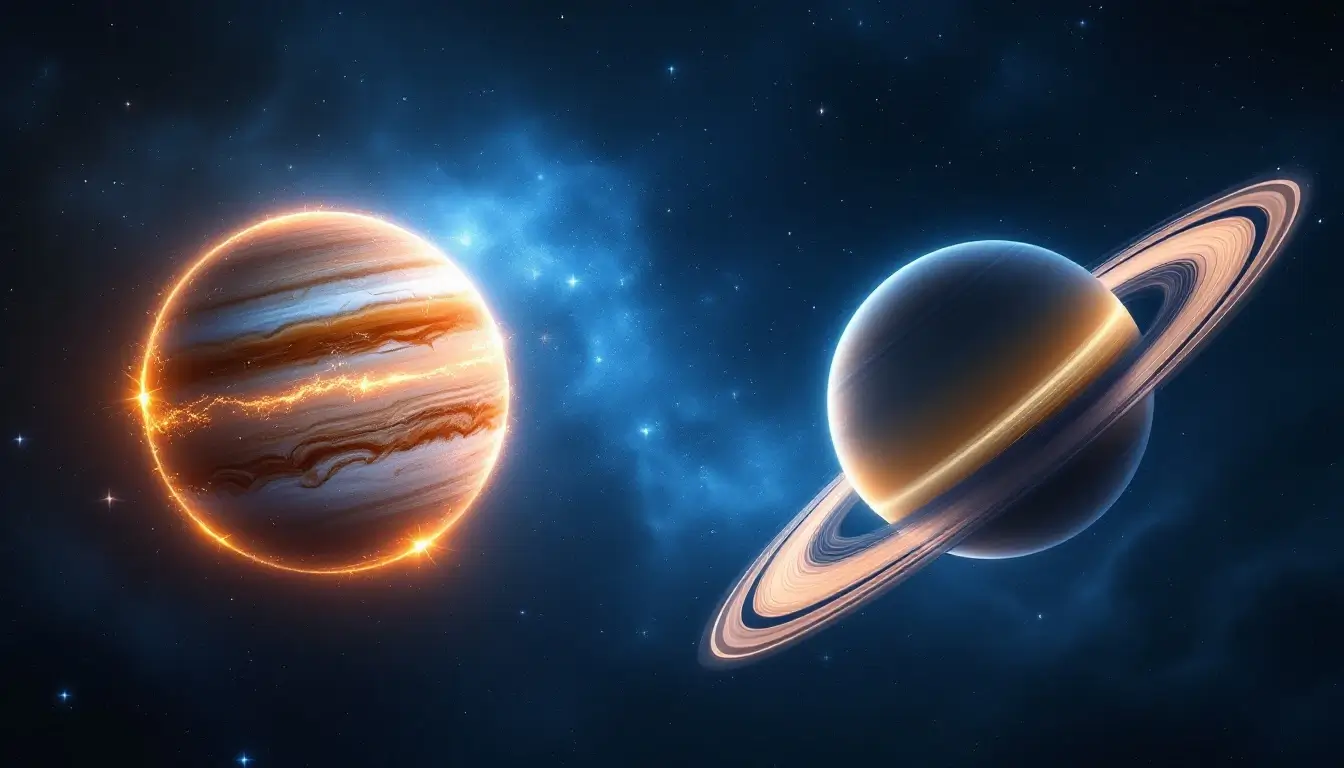
Jupiter and Saturn are the bridge between your personal world and the wider one. They move slowly enough to color entire seasons and years of your life, and they represent a classic push-and-pull: expansion versus structure, faith versus discipline.
Jupiter: Growth, Luck & Expansion
Jupiter is astrology’s great expander. Wherever Jupiter sits in your chart — and wherever it’s currently transiting — is where you’re most likely to experience growth, opportunity, and a generous dose of good fortune. Jupiter spends roughly a year in each sign, which is why “Jupiter in [sign]” transits tend to define an entire year’s cultural mood, from travel booms to shifts in collective optimism.
Saturn: Structure, Limits & Mastery
Saturn has an undeserved reputation as astrology’s villain, but it’s more accurate to think of it as the strict-but-fair mentor. Saturn shows you exactly where you need to build discipline, patience, and long-term structure — and it rewards that effort generously once you put in the work. Saturn spends about two and a half years in each sign, and its most famous transit, the Saturn Return, happens roughly every 29 years and marks a major coming-of-age moment.
Together, Jupiter and Saturn form one of astrology’s oldest storylines: expansion versus contraction, “yes and more” versus “not yet, not like this.” Every twenty years or so the two planets meet in a conjunction that astrologers use to mark the start of new multi-decade eras — a reminder that even the social planets, slow as they are, still move in a rhythm you can learn to anticipate.
Which Planet Rules Your Zodiac Sign?
Every one of the twelve zodiac signs has a “ruling planet” — the planet that most closely matches its energy and, in traditional astrology, governs it. Knowing your Sun sign’s ruler is a shortcut to understanding a huge chunk of your chart at a glance, and it’s also why certain planetary transits hit some signs much harder than others. When Saturn moves through Capricorn, for instance, Capricorns feel it most intensely, because Saturn is their planet coming home.
| Zodiac Sign | Ruling Planet | Modern Co-Ruler |
|---|---|---|
| Aries | Mars | — |
| Taurus | Venus | — |
| Gemini | Mercury | — |
| Cancer | Moon | — |
| Leo | Sun | — |
| Virgo | Mercury | — |
| Libra | Venus | — |
| Scorpio | Mars (traditional) | Pluto |
| Sagittarius | Jupiter | — |
| Capricorn | Saturn | — |
| Aquarius | Saturn (traditional) | Uranus |
| Pisces | Jupiter (traditional) | Neptune |
Notice that three signs — Scorpio, Aquarius, and Pisces — have two rulers listed. That’s because ancient astrologers, working before Uranus, Neptune, and Pluto were even discovered, assigned Mars, Saturn, and Jupiter as their traditional rulers. Once the outer planets were found, modern astrologers reassigned them as better symbolic matches. Most contemporary astrologers now blend both: the traditional ruler still matters for grounded, practical guidance, while the modern ruler captures the sign’s deeper, more mysterious layer.
The Generational Planets: Uranus, Neptune & Pluto
Uranus, Neptune, and Pluto move so slowly — Uranus takes 84 years to circle the zodiac, Neptune takes 165, and Pluto takes roughly 248 — that their sign placements say almost nothing about you individually and everything about the generation you belong to. Everyone born within a several-year window shares the same sign for each of these planets.
Uranus: Rebellion, Innovation & Sudden Change
Uranus rules disruption, originality, and the unexpected. It’s the planet behind breakthrough technology, social revolutions, and the “out of nowhere” life changes that reroute your path entirely. Its house placement in your personal chart is where you’re most likely to buck convention.
Neptune: Dreams, Spirituality & Illusion
Neptune governs imagination, intuition, spirituality, and — its shadow side — illusion and escapism. It dissolves boundaries, which makes it the planet of artists and mystics alike, but also the planet most associated with confusion and self-deception when it’s poorly integrated.
Pluto: Transformation, Power & Rebirth
Pluto is astrology’s planet of total transformation — the death-and-rebirth cycle, the shadow self, and raw power. Pluto’s house placement in your chart marks the area of life where you’ll experience your most profound, identity-altering evolution.
Curious what your generational placements actually mean day-to-day? Understanding the sign is only half the story — the house each planet falls in is where the real, personal meaning lives, and it’s one more reason a well-chosen piece of celestial jewelry can be a genuinely meaningful daily reminder of your chart. Our Specialty Leo Zodiac Necklace is a favorite way our readers carry their sign with them.
Chiron, the Wounded Healer: Astrology’s Unofficial 11th Planet

Most planet-meaning guides stop at Pluto, but Chiron deserves a seat at the table. Technically a “centaur” — a small icy body orbiting between Saturn and Uranus, not a planet at all — Chiron has earned its place in modern astrology because its symbolism runs so deep.
Named after the wounded centaur of Greek myth who became a healer despite (and because of) his own incurable injury, Chiron represents your core wound — the tender, often painful place you carry from early in life — and, paradoxically, the exact spot where you’re capable of the deepest healing, both for yourself and for others. Chiron’s house and sign placement in your chart often points to the very thing you eventually build a career, a passion, or a calling around, precisely because you understand that particular pain so intimately.
Where Chiron sits in your chart isn’t just where you were hurt — it’s where you become someone else’s medicine.

Wear Your Planets, Not Just Read About Them
Our handmade Pure Silver Horoscope Pendant is laser-etched with your sign’s symbol and comes on a 16-inch chain — a daily reminder of the planetary energy that rules you.
How to Find Your Planets: Signs, Houses & What’s Active Right Now
Knowing what each planet means is step one. Step two is finding out where your own planets actually sit — and that requires your exact birth date, time, and location, run through a natal chart calculator. If you haven’t done this yet, our complete guide to birth charts walks you through generating and reading your own chart from scratch, no astrology background required.
But sign placement is only half the picture. Every planet also falls into one of the twelve houses — the areas of life (career, relationships, home, self-image, and so on) where that planet’s energy plays out. A Jupiter in Leo means something different in your career-focused tenth house than it does in your relationship-focused seventh house, even though the sign is identical. Our astrology houses meaning guide covers all twelve in depth, and pairing it with this planets guide is the fastest way to actually read your own chart rather than just memorizing keywords.
It also helps to separate two very different questions: “where was this planet when I was born?” (your natal placement, fixed forever) versus “where is this planet right now?” (a transit, constantly shifting). Your natal Venus never changes, but transiting Venus moves through all twelve signs every single year, brushing past your natal planets and triggering short-term shifts in mood and circumstance. This is the difference between “who you are” and “what’s happening to you this week” — and confusing the two is the most common mistake beginners make when reading horoscopes.
One more layer worth knowing: planets also move through cycles of direct and retrograde motion, and they express themselves differently depending on whether your chart’s dominant energy is cardinal, fixed, or mutable. As of late September 2026, for example, five bodies — Saturn, Uranus, Neptune, Pluto, and Chiron — are all retrograde at once, which is unusually common in late summer and fall, when the outer, slower-moving planets tend to stack their annual retrograde stations one after another. Retrograde periods aren’t something to fear; they’re simply invitations to revisit, review, and revise whatever that planet governs, rather than push forward on something new. A retrograde Mercury asks you to double-check the fine print; a retrograde Saturn asks you to re-examine a commitment or responsibility you took on long ago.
Frequently Asked Questions About Planets in Astrology
How many planets are used in astrology?
Astrology traditionally uses ten “planets”: the Sun, Moon, Mercury, Venus, Mars, Jupiter, Saturn, Uranus, Neptune, and Pluto. Many modern astrologers also include Chiron, and some incorporate additional asteroids and points, but the classical ten remain the foundation of any chart reading.
What is the most important planet in astrology?
There isn’t a single “most important” planet — your Sun, Moon, and rising sign (the “Big Three”) together give the most complete personality snapshot, but every planet plays a meaningful role depending on what question you’re asking.
What does it mean when a planet is retrograde?
A retrograde planet appears to move backward through the zodiac from our vantage point on Earth. It’s an optical illusion, not an actual reversal in orbit, but astrologically it’s treated as a period to slow down, reflect, and revisit issues related to that planet rather than launch new ones.
What’s the difference between a personal planet and a generational planet?
Personal planets (Sun, Moon, Mercury, Venus, Mars) move quickly and describe your individual personality and daily experience. Generational planets (Uranus, Neptune, Pluto) move so slowly that they describe traits shared by everyone born around the same time as you, rather than anything unique to you alone — the personal flavor comes from the house they occupy in your specific chart.
Do the planets in astrology match the actual planets in the sky?
Mostly, yes — astrology tracks the real positions of the Sun, Moon, and eight planets (plus Chiron) as seen from Earth. The difference is interpretive: astronomy studies their physical properties, while astrology studies the symbolic meaning of their positions and movements.
How do I find out where my planets are?
You’ll need your exact birth date, time, and location, then run them through a natal chart calculator to generate your full birth chart. See our birth chart guide for a full walkthrough.
Final Thoughts: Your Planets Are a Map, Not a Verdict
Learning what each planet means in astrology isn’t about memorizing a fixed set of traits — it’s about building a vocabulary for understanding yourself and the world with more nuance. Your Sun isn’t “better” than your Moon, and a challenging Saturn placement isn’t a life sentence; it’s an invitation to grow into exactly the kind of person who can handle what that placement asks of you. The more fluently you can read your own planets, signs, and houses together, the more your birth chart stops feeling like a horoscope column and starts feeling like a genuinely useful mirror.

Your Stars, Your Inbox
Get weekly horoscope insights, cosmic guidance, and exclusive offers delivered straight to your inbox. Join our community of star-seekers today.