Have you ever read a horoscope that said “Mars squares Uranus today” and wondered what on earth a square has to do with your Tuesday? You’re in the right place. Aspects in astrology are the angles that planets make to one another, and they’re the secret language that turns a list of placements into a living, breathing story. Your Sun sign tells you who you are. Your aspects tell you how all the different parts of you get along.
In this beginner-friendly guide to aspects in astrology, you’ll learn the five major aspects (conjunction, sextile, square, trine and opposition), how orbs work, why an aspect that’s “applying” feels stronger than one that’s “separating”, which minor aspects are worth knowing, and how to spot famous patterns like the Grand Trine and the T-Square. Then we’ll walk through how to find and read the aspects in your own birth chart in about ten minutes, using real examples from the sky above us right now in November 2026.
What Are Aspects in Astrology?

Picture the zodiac as a 360-degree circle, with every planet sitting somewhere on that wheel. An aspect is simply the angle between two planets, measured in degrees around the circle. When two planets sit at certain special distances from each other (0°, 60°, 90°, 120° or 180°), astrologers say they are “in aspect”, and their energies start to talk to each other.
Here’s a plain-English way to think about it. Each planet is a character with its own job: the Moon is your feelings, Mercury is your mind, Venus is your heart, Mars is your drive. On its own, each character just does its thing. An aspect is a relationship between two characters. Some relationships are easy friendships, some are creative partnerships, and some are like roommates who keep arguing about the dishes but end up teaching each other a lot.
That’s why two people with the same Sun, Moon and rising sign can still feel completely different. One might have Venus in a flowing trine to Jupiter (generous, lucky in love), while the other has Venus in a tense square to Saturn (cautious, slow to trust, but deeply loyal once committed). Same signs, different conversations.
Why the Angles Mean What They Mean
The magic numbers aren’t random. Each major aspect comes from dividing the 360° circle by a whole number:
- Divide by 1 (0°): the conjunction, two planets fused into one point.
- Divide by 2 (180°): the opposition, two planets facing each other across the wheel.
- Divide by 3 (120°): the trine, the harmonious triangle.
- Divide by 4 (90°): the square, the dynamic cross.
- Divide by 6 (60°): the sextile, the friendly six-pointed star.
Astrologers going all the way back to Ptolemy in the 2nd century used these five angles, which is why they’re still called the Ptolemaic or major aspects. In the early 1600s, the astronomer Johannes Kepler added several “minor” aspects, which we’ll get to shortly.
Aspects Follow the Signs, Too
There’s an elegant shortcut hiding in the zodiac itself. Because each sign spans 30°, most aspects line up with how many signs apart two planets are, and that tells you a lot about the aspect’s flavor. Planets in the same element (fire, earth, air or water) sit four signs apart, which is a trine, so they naturally understand each other. Planets in the same modality (cardinal, fixed or mutable) sit three or six signs apart, forming squares and oppositions, so they share a style of action but pull in different directions. Keep this in mind and the meanings below will start to feel intuitive rather than memorized.
The 5 Major Aspects in Astrology
These are the big five aspects in astrology. If you only learn one thing from this guide, learn these. For each one, you’ll find its angle, its keyword, how it tends to feel, and a real example from the 2026 sky so you can watch it play out in real time.
| Aspect | Symbol | Angle | Signs apart | Typical orb | Energy |
|---|---|---|---|---|---|
| Conjunction | ☌ | 0° | Same sign | 8–10° | Fusion, intensity, new beginnings |
| Sextile | ⚹ | 60° | 2 signs | 4–6° | Opportunity, friendly support |
| Square | □ | 90° | 3 signs | 6–8° | Tension, friction, motivation |
| Trine | △ | 120° | 4 signs | 6–8° | Harmony, natural talent, ease |
| Opposition | ☍ | 180° | 6 signs | 8–10° | Awareness, balance, relationships |
Orbs are guidelines, not laws. Many astrologers allow a few extra degrees when the Sun or Moon is involved.
Conjunction (0°): The Merger
When two planets sit right next to each other, their energies blend into one powerful blast. A conjunction isn’t “good” or “bad” on its own. It depends entirely on which planets are teaming up. Venus with Jupiter feels like a warm hug from the universe; Mars with Saturn feels like trying to sprint in heavy boots. Conjunctions also mark beginnings, which is why the New Moon (the Sun and Moon conjunct) is the classic time to set intentions.
2026 example: Mars meets Jupiter at nearly 26° Leo in the early hours of November 16, 2026 (about 1:23 a.m. ET). Expect a surge of confidence, big-hearted courage and “go for it” energy, especially for Leo, Aries and Sagittarius. Read more about the backdrop in our guide to Jupiter in Leo. And earlier this year, Saturn and Neptune met at 0°45′ Aries on February 20, a once-in-a-generation conjunction we explored in Saturn–Neptune Conjunction 2026.
Sextile (60°): The Open Door
A sextile links planets two signs apart, usually fire with air or earth with water. These elements get along well, so the sextile is friendly, curious and cooperative. The catch is that a sextile is an invitation, not a guarantee. It opens a door, but you have to walk through it. Sextiles reward initiative: say yes to the coffee date, send the email, sign up for the class.
2026 example: The Sun sextiles Pluto on November 25 (12:27 p.m. ET), a good afternoon for an honest, empowering conversation about something you’ve been avoiding.
Square (90°): The Growth Spurt
Squares link planets three signs apart, in signs that share a modality but have incompatible elements: fire or air squaring earth or water. They want different things in the same urgent way, and that friction creates pressure. Squares often get a bad rap, but they’re actually the engine of achievement. Many successful people have charts full of squares, because tension is what pushes us to act, adapt and grow.
2026 example: The Sun squares Mars on November 19 (12:49 p.m. ET), and Mars squares Uranus on December 4 (2:28 p.m. ET). Both are classic “short fuse, big breakthrough” days. Channel the energy into a workout or a bold project rather than an argument.
Trine (120°): The Easy Flow
Trines join planets four signs apart, in the same element, so they speak the same language. A trine feels natural, lucky and effortless, like a gift you were born with. The only downside? Because trines are so comfortable, we sometimes take them for granted. The talent is there, but it may stay half-used unless a square or opposition nudges you into using it. (We dig into the triangle itself in Understanding Astrological Trines.)
2026 example: Uranus in Gemini trines Pluto in Aquarius, exact on November 29, 2026. It’s a rare generational aspect with five exact passes between July 2026 and May 2028, and the last time these two planets formed a trine was 1921–1922. It’s an easy-flow aspect that’s quietly rewiring how we talk, connect and gather. Learn more in Uranus in Gemini 2026 and Pluto in Aquarius.
Opposition (180°): The Mirror
An opposition places two planets on opposite sides of the zodiac, like Aries and Libra or Taurus and Scorpio. These sign pairs are natural partners that cover opposite ends of the same theme (self vs. others, security vs. transformation). Oppositions create a seesaw: you might swing between two needs until you learn to hold both at once. Because they’re about “the other side”, oppositions often show up through other people, which makes them central in relationship astrology.
2026 example: The Sun opposes Uranus on November 25 (5:41 p.m. ET). That’s one day after the November 2026 Full Moon in Gemini, which is itself an opposition between the Sun and Moon. Expect surprises from others and a sudden urge for freedom.
Orbs, Applying vs. Separating: Why Some Aspects Hit Harder
When you start working with aspects in astrology, you’ll notice that planets rarely sit at a perfect 90° or 120° from each other. That’s where the orb comes in: the wiggle room, in degrees, that astrologers allow before an aspect “counts”. A square at 89° is still a square. A square at 81° is a stretch for most astrologers. The tighter the orb, the louder the aspect.
How Big an Orb Should You Use?
There’s no single official rule, and astrologers happily debate this one. A good beginner’s rule of thumb:
- Conjunctions and oppositions: up to 8–10°, slightly more if the Sun or Moon is involved.
- Squares and trines: about 6–8°.
- Sextiles: about 4–6°.
- Minor aspects (like the quincunx): just 1–3°.
- Transits (today’s planets touching your birth chart): keep it tight, about 1–2°, because that’s when you’ll actually feel it.
Start with these, then trust your own experience. If an aspect at 7° describes you perfectly, it counts.
Applying vs. Separating Aspects
Here’s a nuance that almost no beginner guide covers, yet it changes how you read the sky. Planets move at different speeds. When a faster planet is moving toward an exact aspect with a slower one, the aspect is applying. Once it has passed exact and is pulling away, it’s separating.
Applying aspects feel like a building wave: anticipation, momentum, events still unfolding. Separating aspects feel like the wave rolling back: integration, reflection, consequences settling in. Many astrologers consider applying aspects the stronger of the two.
You can watch this happen right now. On November 12, 2026, Mars is at about 24° Leo and Jupiter at about 25.5° Leo. Mars moves faster, so it’s applying to Jupiter. The conjunction perfects on November 16, and then Mars separates. If you’ve felt a growing itch to take a confident leap this week, that’s the applying conjunction building.
In a birth chart, the same logic applies. If your Moon (the fastest body) is applying to a trine with Venus, many astrologers read that as a gift that grows over your lifetime. If it’s separating, the gift is more like an inheritance you’re already carrying.
Out-of-Sign Aspects
Occasionally the degrees and the signs disagree. Imagine one planet at 29° Aries and another at 1° Leo. They’re 92° apart, which is a square by degree, yet Aries and Leo are both fire signs, normally a trine relationship. This is called an out-of-sign (or dissociate) aspect. It still works, but its flavor is mixed: a square with an unexpectedly friendly undertone. Most astrologers count it, just a little more gently.
Minor Aspects Worth Knowing
The minor aspects in astrology are the fine print of your chart. They’re subtler than the big five and use much tighter orbs, but a few of them are well worth learning, especially the quincunx.
Quincunx or Inconjunct (150°)
The quincunx links planets five signs apart, signs with nothing in common: different element, different modality, different polarity. Think of a Taurus and a Sagittarius trying to plan a vacation together. The result is a feeling of awkwardness, like an itch you can’t quite reach, that calls for constant small adjustments rather than one big fix. Quincunxes are often linked with health routines, habits and “fine-tuning” themes.
2026 example: This week, retrograde Mercury at about 5° Scorpio is within about a degree of a quincunx to Uranus at 4° Gemini, just as Mercury stations direct on November 13. It’s perfect energy for editing a plan rather than scrapping it.
Semi-Sextile (30°)
Planets in neighboring signs, like Aries and Taurus. Mildly uncomfortable at first, because neighboring signs have different elements, but it can grow into a useful partnership with a little effort.
Semi-Square (45°) and Sesquiquadrate (135°)
Think of these as “mini-squares”. They create low-level irritation and restlessness rather than full-blown tension. Pay attention to them when they’re very tight (within 1–2°).
Quintile (72°) and Bi-Quintile (144°)
Kepler’s favorites. Born from dividing the circle by five, quintiles are linked with creativity, unusual talents and personal style. Many astrologers look for them in the charts of artists and inventors.
Aspect Patterns: Grand Trine, T-Square, Yod & Stellium
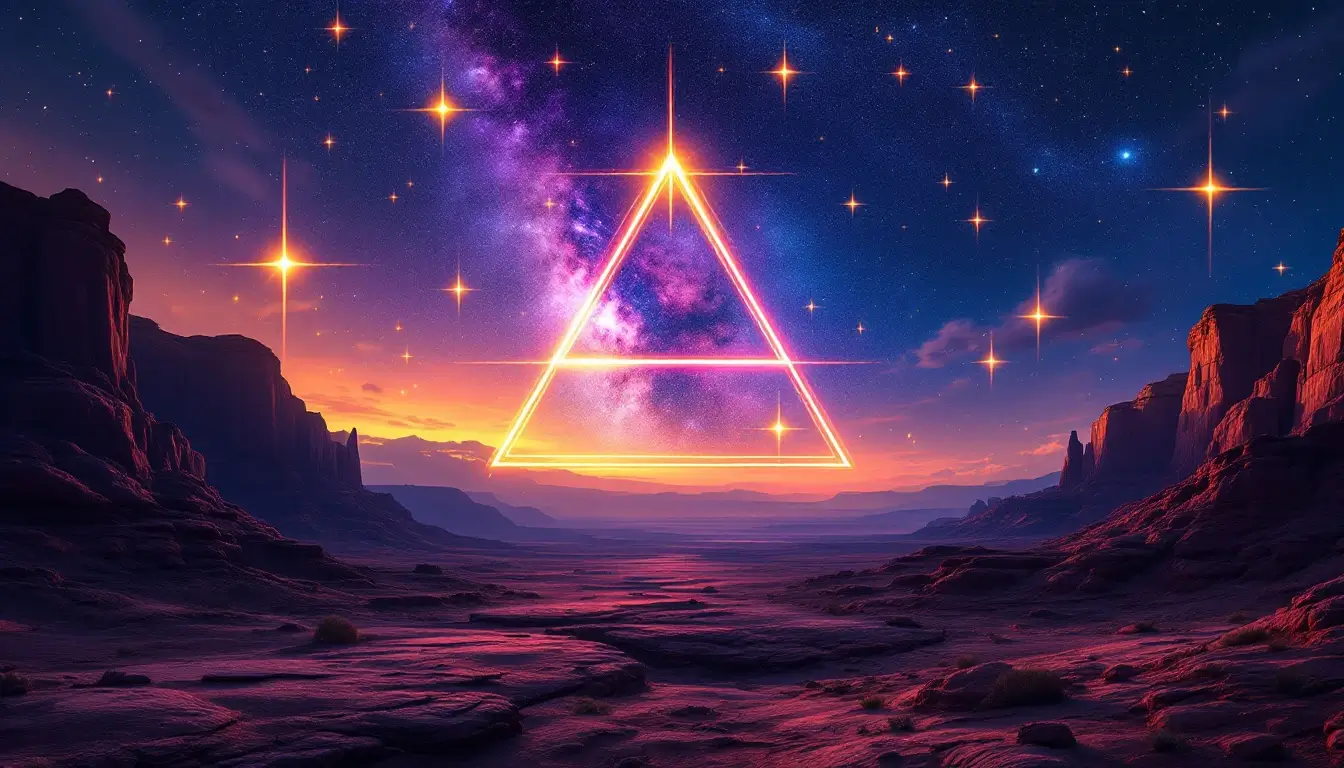
When three or more planets link up through several aspects at once, they form a pattern, a kind of constellation inside your chart. Patterns are the big-picture themes of aspects in astrology, and if you have one, it often becomes a defining story of your life.
Grand Trine
Three planets, each trine the others, forming a perfect triangle within one element. A fire Grand Trine brings inspiration and confidence, earth brings practical skill, air brings ideas and social ease, and water brings emotional intuition. It’s a wonderful gift, but it can make life so comfortable that you coast. The key is to put the talent to work on purpose.
Minor Grand Trine (Happening Now!)
Two planets in a trine, with a third planet sextile both and sitting at the midpoint. It’s a “talent triangle” with a built-in outlet. Here’s the exciting part: there’s one in the sky right now. Uranus at about 4° Gemini trines Pluto at about 3° Aquarius, while Neptune at about 2° Aries sextiles both of them. Uranus sextile Neptune perfects again on January 15, 2027. This rare slow-moving trio of outer planets suggests that the big shifts of 2026–2028, in technology, community and spirituality, have real potential to flow constructively rather than chaotically. Neptune and Saturn’s journey through Aries is the “outlet” point; see our Saturn in Aries 2026 and Neptune in Aries guides.
T-Square
Two planets in opposition, both square a third planet that sits at the point of the “T” (the apex). It’s the most common major pattern and one of the most motivating. The apex planet is where the pressure gets released, so it often points to your biggest area of drive and accomplishment.
Grand Cross
Two oppositions crossing each other, with four planets squaring their neighbors and forming a cross. It’s intense, like being pulled in four directions, but people with a Grand Cross often become remarkably resilient, balanced and capable under pressure.
Yod (the “Finger of God”)
Two planets in a sextile, both quincunx a third planet at the apex. The shape is a long, narrow triangle pointing at the apex planet, which is said to carry a sense of special mission or calling. It often feels like a nagging pull toward a purpose you can’t ignore.
Kite
A Grand Trine with a fourth planet opposing one corner (and sextile the other two). The opposition gives the easy Grand Trine a direction and a “string” to fly by, turning talent into achievement.
Stellium
Technically not an aspect pattern but a cluster: three or more planets packed into one sign or house, usually all conjunct one another. A stellium puts a huge spotlight on that sign’s or house’s themes. If you have a stellium in your 10th house, for instance, career and public life are likely to be major threads in your story. (Not sure what the houses mean? Start with our guide to the 12 birth chart houses.)
How to Find and Read the Aspects in Your Birth Chart
Ready to try reading aspects in astrology on your own chart? Here’s a simple ten-minute method. All you need is your birth date, time and place. (New to charts? Start with What Is a Birth Chart? and come back.)
Step 1: Pull Up Your Chart and Find the Aspect Grid
Generate your free natal chart with any reputable chart calculator. Most charts show colored lines criss-crossing the center of the wheel: those lines are your aspects. Usually red or black lines mark the tense aspects (squares and oppositions) and blue or green lines mark the harmonious ones (trines and sextiles). Many calculators also print an aspect grid, a stair-step table that lists every planet down one side and across the other, with the aspect symbol where they meet.
Step 2: Start With the Tightest Aspects
Your grid usually lists the orb next to each aspect. Circle the three aspects with the smallest orbs (ideally under 3°). These are the loudest voices in your chart, the ones you’ll recognize instantly in your daily life.
Step 3: Prioritize the Personal Points
Aspects involving your Sun, Moon, Ascendant and the ruler of your Ascendant matter most, because they describe your core identity, emotional needs and how you meet the world. A Moon–Saturn square is far more personal than a Neptune–Pluto sextile that everyone born in your decade shares. (In fact, Neptune and Pluto have been sextile, on and off, for most of the past eight decades, so it’s a generational signature rather than a personal one.)
Step 4: Read the Sentence
Every one of the aspects in astrology can be translated into a simple sentence: [Planet A’s need] + [aspect’s verb] + [Planet B’s need]. For example:
- Moon trine Venus: “My emotions flow easily with my capacity for love and beauty.” Warm, affectionate, a natural people-pleaser.
- Mercury square Mars: “My thinking clashes with and is fired up by my drive.” Quick-witted and debate-loving, sometimes a sharp tongue.
- Sun opposite Saturn: “My identity is mirrored by my sense of duty.” Responsibility arrives early, maturity is earned, and the payoff grows with age.
Then add the signs and houses for color. A Moon–Venus trine in water signs is soulful and nurturing; in air signs it’s sociable and charming.
Step 5: Look for Patterns and Missing Pieces
Scan for Grand Trines, T-Squares or stelliums. Also notice any planet that makes no major aspects at all (an unaspected planet). It tends to act independently, like a talent that switches fully “on” or fully “off”. Our step-by-step guide to reading a birth chart shows how aspects fit together with signs and houses.
Pro tip: write your three tightest aspects on a sticky note and keep them on your mirror for a week. You’ll be amazed how often they describe your reactions perfectly. If your chart has a fiery Mars–Jupiter link like this month’s sky, you might want to wear that confidence proudly in our Cute Leo Girl Constellation T-Shirt, a cheerful nod to the boldest sign in the zodiac.
Aspects in Transits and Relationships

Once you understand natal aspects in astrology, you’ve unlocked the two most practical uses of astrology: timing (transits) and compatibility (synastry). Both use exactly the same five aspects.
Transits: Today’s Sky Talking to Your Chart
A transit is when a planet moving through the sky today forms an aspect to a planet in your birth chart. If Saturn is currently at 8° Aries and your natal Sun is at 8° Cancer, transiting Saturn is squaring your Sun. That’s a season of hard work, restructuring and growing up in some area of your life. Slow planets (Jupiter through Pluto) create long chapters lasting months or years, while fast planets (Sun, Moon, Mercury, Venus, Mars) create moods that last hours or days. Our birth chart transits guide walks through how to track them.
Here are the major aspects in the sky over the next few weeks, so you can practice spotting them (all times US Eastern, calculated with Swiss Ephemeris):
| Date (ET) | Aspect | Degrees | The vibe |
|---|---|---|---|
| Nov 16, 1:23 a.m. | Mars ☌ Jupiter | 25°54′ Leo | Courage, generosity, big swings |
| Nov 19, 12:49 p.m. | Sun □ Mars | 27° Scorpio / Leo | Willpower tested; channel, don’t clash |
| Nov 23, 7:07 p.m. | Sun △ Neptune | 1° Sagittarius / Aries | Inspired, dreamy, intuitive |
| Nov 25, 5:41 p.m. | Sun ☍ Uranus | 3° Sagittarius / Gemini | Surprises, breakthroughs, freedom |
| Nov 29 | Uranus △ Pluto | 3° Gemini / Aquarius | Generational, constructive change |
| Dec 4, 2:28 p.m. | Mars □ Uranus | 3° Virgo / Gemini | Restless, inventive, sudden moves |
| Jan 15, 2027, 4:30 a.m. | Uranus ⚹ Neptune | 1°56′ Gemini / Aries | Visionary ideas, spiritual tech |
If you have planets at the same degrees in your own chart (give or take 1–2°), these dates will be especially personal for you.
Synastry: Aspects Between Two Charts
In synastry, you lay two birth charts on top of each other and look at the aspects between one person’s planets and the other’s. Your Venus trine their Mars? Natural attraction. Your Moon square their Saturn? You might feel criticized, while they feel responsible for you. Some of the most lasting bonds include a few challenging aspects, because squares and oppositions create the friction that keeps a relationship growing. Explore more in our synastry chart guide and birth chart compatibility guide.

Connect the Stars, Wear Your Constellation
Aspects are all about the lines that connect the stars. Our Pure Silver Horoscope Constellation Ring traces the Leo constellation in sterling silver, a sweet way to celebrate this month’s Mars–Jupiter conjunction in Leo or to gift the lionhearted soul in your life. Every other sign’s constellation is in the shop, too.
Aspects in Astrology FAQ
How many aspects in astrology are there?
Most astrologers work with five major aspects in astrology (conjunction, sextile, square, trine and opposition) plus a handful of minor ones, most commonly the quincunx, semi-sextile, semi-square, sesquiquadrate and quintile. Beginners can get a remarkably accurate reading from the five majors alone.
Is a square aspect bad?
No. Squares are challenging, not bad. They create friction that pushes you to act, learn and build strength. Many accomplished people have charts full of squares. A chart with only trines can actually feel a little unmotivated. Think of squares as your personal trainer: tough in the moment, rewarding in the long run.
What is the most powerful aspect in astrology?
The conjunction is generally considered the strongest because the two planets fuse into one point, followed by the opposition and the square. In practice, though, the most powerful aspect in your chart is the one with the tightest orb involving your Sun, Moon or Ascendant.
What orb should I use for aspects?
A common starting point is 8–10° for conjunctions and oppositions, 6–8° for squares and trines, 4–6° for sextiles and 1–3° for minor aspects. For transits, use 1–2°. These are guidelines; adjust based on what you notice in real life.
What’s the difference between hard and soft aspects?
Hard aspects (conjunctions of challenging planets, squares and oppositions) create tension and motivation. Soft aspects (trines and sextiles) create ease and opportunity. A healthy chart usually has a mix of both, so you get talents and the drive to use them.
Do aspects to the Ascendant and Midheaven count?
Yes, if you know your exact birth time. Planets aspecting your Ascendant shape your personality and first impression, while aspects to the Midheaven color your career and public image. If your birth time is uncertain, focus on planet-to-planet aspects instead. (Learn more in our rising sign guide.)
What does it mean if a planet has no aspects?
An unaspected planet doesn’t “talk” easily with the rest of your chart. Its energy can feel either very pure and intense or hard to access. Many people with an unaspected planet find that it becomes a standout talent once they consciously develop it.
Do aspects work the same way in transits and synastry?
Yes. The meaning of each aspect stays the same: a trine is still easy, a square is still dynamic. What changes is the context. In transits, it’s the sky meeting your chart for a period of time. In synastry, it’s your chart meeting someone else’s.
Final Thoughts: Your Chart Is a Conversation
Learning aspects in astrology is like learning to hear the music behind the lyrics. Your signs tell you what your planets want, your houses tell you where it plays out, and your aspects tell you how all those parts of you work together. The trines are your gifts. The squares are your growth edges. The oppositions are your mirrors. None of them is a sentence; every one of them is an invitation.
Start small. Find your three tightest aspects, write them down, and watch for them over the next week. Then, when you see “Mars conjunct Jupiter” or “Uranus trine Pluto” in a horoscope this month, you’ll know exactly what it means, and how to make the most of it. ✨

Your Stars, Your Inbox
Get weekly horoscope insights, cosmic guidance, and exclusive offers delivered straight to your inbox. Join our community of star-seekers today.